How Blockchain Is Making Pet Ownership Fraud-Proof
Published 5/11/2026
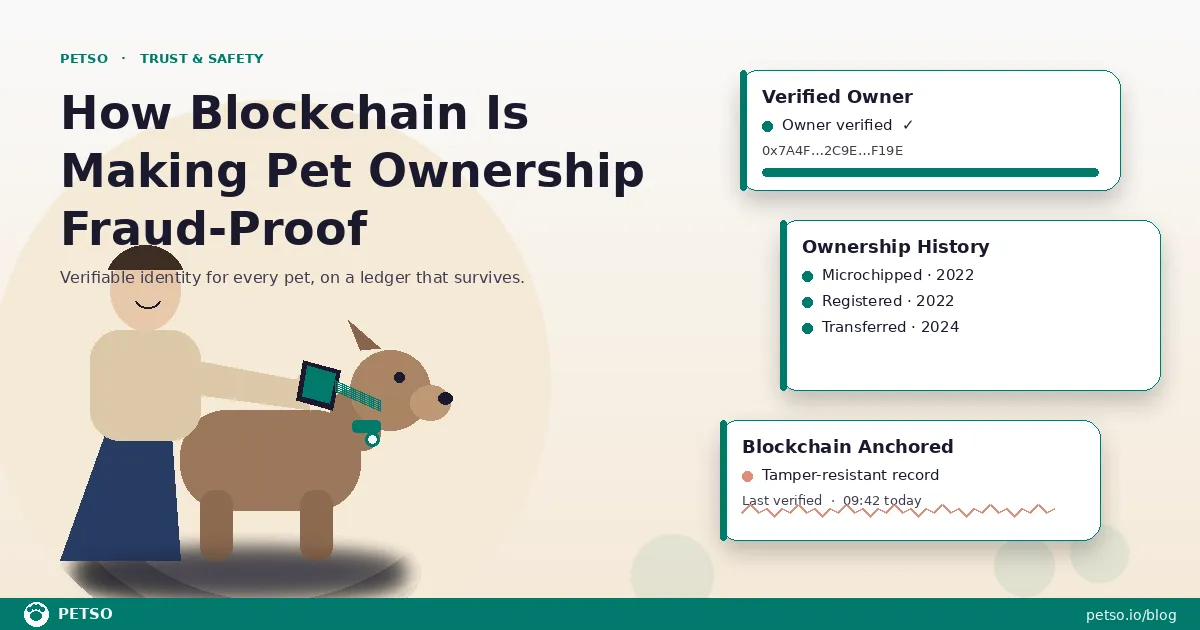
How Blockchain Is Making Pet Ownership Fraud-Proof
Imagine this. You see a French Bulldog puppy for sale online. The seller has photos, a microchip number, even a vaccination card. You hand over £2,500 in cash, drive home with a wriggly new family member, and a week later get a call from a vet 80 miles away saying the chip is registered to someone else — someone whose dog was stolen from a back garden three weeks ago. Now you’re heartbroken, the original family is heartbroken, and the seller has vanished. Stories like this one have become uncomfortably common. Pet thefts in the United States are up roughly 150% over the last five years, and an estimated 2.7 million pets are stolen each year. Fewer than 30% are ever returned. Behind those numbers sits a quieter problem: the systems we use to prove who a pet belongs to were never designed for the world we’re living in now.
Why Pet Ownership Is Surprisingly Easy to Fake
For something so emotionally valuable, proof of pet ownership is shockingly thin. A receipt from a breeder, a vaccination booklet that anyone can buy blank online, a microchip number that may or may not be registered to the correct person. That’s it. There is no equivalent of a car title, no central deed office, no single trusted source.
The microchip itself was a real step forward when it became mainstream in the 1990s, but the registry layer around it never caught up. Today, pet microchip data is scattered across more than 7,000 disconnected databases in the United States alone. A vet who scans a chip sees a 15-digit number and then has to guess which registry it lives in. Researchers have found that around 35.4% of contact information attached to microchipped pets entering shelters is out of date or simply wrong — old phone numbers, previous addresses, registrations that were never completed in the first place.
And registries themselves can disappear. In early 2025, one well-known microchip registry company quietly ceased operations, leaving thousands of owners scrambling to re-register their pets elsewhere. If your only proof of ownership lives in a database that one company controls, your “proof” is exactly as durable as that company’s balance sheet.
Fraudsters have noticed. Stolen pets are re-chipped or “re-registered” with falsified paperwork. Backyard breeders pass off mixed-breed puppies as pedigree by forging lineage documents. Online scammers sell the same animal to multiple buyers using copy-pasted photos. The tools we use to verify ownership were built for a slower, more local world — and they’re being outpaced.
What Blockchain Actually Does Here (Without the Hype)
Strip away the buzzwords and a blockchain is really just one thing: a shared record that no single party can quietly rewrite. Every entry is time-stamped, cryptographically linked to the entry before it, and visible to anyone authorised to look. If you’ve ever wished there was a tamper-resistant, always-on logbook for important events in your pet’s life, that’s the shape of what a blockchain offers.
For pet ownership, three properties matter most. First, immutability — once an event is recorded (a chip implant, a transfer of ownership, a vaccination), it cannot be silently edited or deleted later. Second, portability — the record exists independently of any single company or registry, so it survives even if a particular service shuts down. Third, verifiability — anyone with the right permissions can confirm that a record is authentic without having to trust the person showing it to them.
Combine those with privacy-preserving cryptography (techniques like zero-knowledge proofs, which let you prove a fact without revealing the underlying data) and you get something useful: an owner can prove “yes, I have legally owned this pet since 2023” to a vet, a border agent, or a buyer, without exposing their full address book and medical history to a stranger. The U.S. Federal Trade Commission has warned for years about the pet sale scams that flourish online; verifiable ownership history is one of the few defences that actually scales.
The global pet microchip market, valued at around $444 million in 2025, is forecast to nearly double by 2033 according to recent industry analysis. The interesting part isn’t the chips themselves — it’s that almost every credible roadmap now assumes those chips will be paired with a verifiable, blockchain-backed registry layer rather than a single corporate database.
The Petso Approach: Identity That Travels With Your Pet
At Petso, we’ve built our digital pet identity layer around exactly this idea: your pet’s identity should belong to you and your pet, not to whichever app or registry happened to onboard you first.
When a pet is registered through Petso, the core ownership record — pet ID, current owner, key life events — is anchored to a blockchain ledger. The sensitive stuff (your contact details, medical notes, payment history) stays encrypted and under your control on the regular app side, but the question “who is the verified owner of this animal, right now?” can be answered cryptographically, in seconds, by any vet, shelter, breeder, or border officer you give permission to ask.
If you sell or rehome your pet, the transfer is recorded as a new event on the chain, signed by both parties. There’s no more “I’ll get round to updating the registry” gap that fraudsters love to exploit. If a microchip is scanned and the chain says the current verified owner is someone else, that’s an instant red flag — long before the new buyer hands over any money.
For vets and shelters, the same system means less detective work. Instead of phoning four registries and hoping one of them returns the call before closing time, a Petso Pro user scans the chip and sees the full verified ownership chain, vaccination history, and any flags for theft or disputed ownership in one screen. For breeders and farms using Farmso, lineage and breeding events get the same tamper-resistant treatment — so a “champion bloodline” claim is either backed by a chain of signed records or it isn’t.
Practical Takeaways for Pet Owners Right Now
You don’t have to wait for the whole industry to modernise to protect yourself. A few sensible habits cover most of the risk.
First, find out which registry your pet’s microchip is actually with, and confirm the contact details are current. The AAHA Universal Pet Microchip Lookup Tool will tell you which registry a number lives in. If you’ve moved, changed phone number, or adopted from a shelter in the last few years, assume the data is wrong until you’ve checked.
Second, when buying a pet — especially a high-value breed — insist on more than a verbal claim. Ask for the microchip number in advance, run it through a lookup tool, and ask the seller to demonstrate a transfer of ownership through whatever registry they use. A legitimate breeder or rehomer will not be offended by this. A scammer will suddenly become very busy.
Third, keep your own independent record. Photos of your pet from multiple angles (including distinctive markings), copies of vet invoices, adoption paperwork, and any registry confirmations all live happily together inside a digital pet profile. If the worst happens and your pet is stolen, the speed and quality of the evidence you can hand to police is often the difference between a recovery and a dead end.
Fourth, if your pet is microchipped but the registry feels flimsy — say, a single-company database with no backup — consider layering a verifiable digital identity on top. The chip stays where it is; you just add a more durable proof-of-ownership record around it.
What This Means for You and Your Pet
The truth is, the technology to make pet ownership genuinely fraud-resistant already exists. Microchips work. Blockchains work. Privacy-preserving identity systems work. What’s been missing is the glue — a layer that ties chip, owner, vet record, and ownership history together in a way that survives company closures, lost paperwork, and bad actors. That layer is being built right now, and pet owners who plug into it early get a quieter, more boring kind of peace of mind: the kind where if your pet is ever lost, stolen, or disputed, you don’t have to prove who you are from scratch. The record already speaks for you.
Where to go from here
- Pet owners: Set up a verified digital profile for your pet with Petso
- Vet professionals: See how Petso Pro handles ownership verification at the clinic
- Learn more: Visit petso.io