The Hidden Costs of Fragmented Pet Data
Published 4/22/2026
The Hidden Costs of Fragmented Pet Data
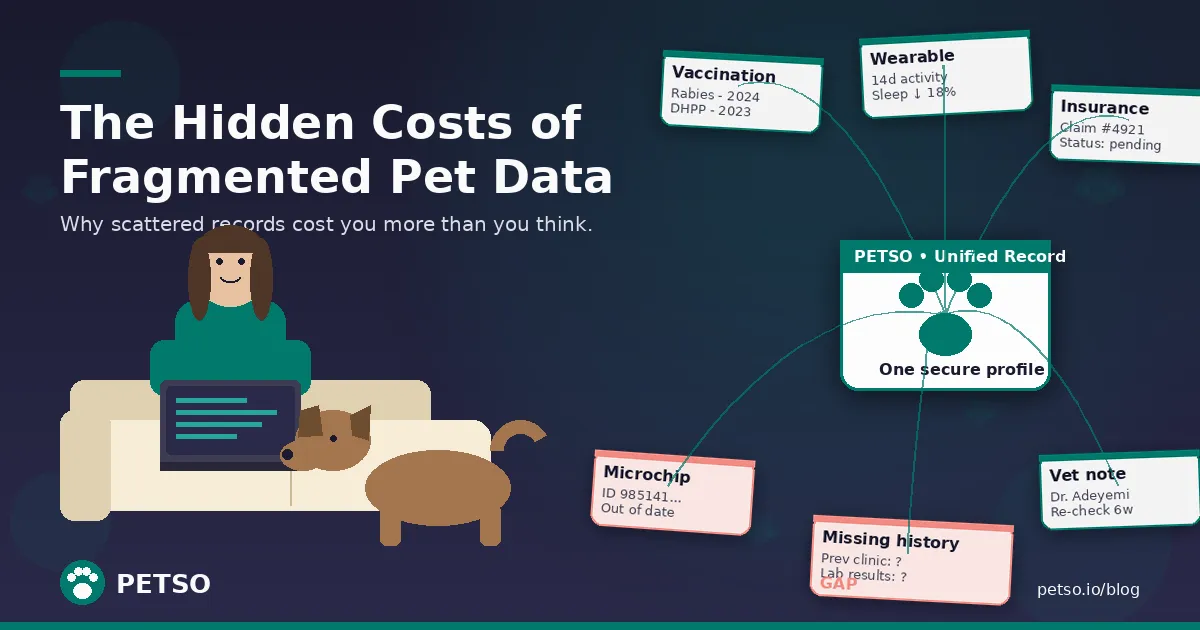
You’ve just moved to a new city and booked your senior cat in with a new vet. She asks, very reasonably, for a medical history. So begins the scavenger hunt. A PDF from the clinic back home. A blurry photo of a vaccination card from two phones ago. A lab result buried in an email chain. Wearable data trapped in an app whose password you’ve forgotten. An insurance file that lists a diagnosis you’ve never heard of. By the time the appointment starts, you’ve become an unpaid medical records clerk — and your cat still hasn’t been examined. If this sounds familiar, you’ve bumped into one of 2026’s quietest pet-care problems: fragmented pet data. And the costs are higher than most owners realise.
How Your Pet’s Data Got So Scattered
A typical pet in 2026 generates more data than the average small business. Every vet visit creates notes, prescriptions, and lab values. Every wearable produces a stream of heart-rate, activity, and sleep metrics. Every groomer logs visits. Every boarding stay adds an intake form. The breeder or shelter you adopted from holds your pet’s original identity record. The insurer holds a claims history. The microchip registry holds a contact card that nobody has updated since 2023.
None of this talks to each other. Veterinary software remains remarkably fragmented, with clinics running a mix of practice management systems, lab portals, imaging platforms, and accounting tools that don’t share data cleanly — even inside the same building. Most daily friction in a clinic comes from disconnected systems: the same patient information typed into three tools, lab values copied by hand, and records that quietly drift out of sync.
The result is a strange inversion. Your pet’s data exists. In many cases it exists in abundance. But you don’t own any single coherent view of it. You own fragments, scattered across apps, clinics, email inboxes, paper cards, and a filing cabinet somewhere at your childhood home. The veterinary industry has known about this fragmentation for years; recent research on digital animal health platforms describes the silos as one of the field’s most stubborn barriers to better care. The part that’s new in 2026 is how expensive the fragmentation has quietly become for everyday pet owners.
What Fragmented Pet Data Actually Costs You
The first cost is money. When your vet can’t see previous test results, the safe clinical answer is to run them again. Bloodwork, urinalysis, imaging, tick panels — all reasonably priced in isolation, all eye-watering when repeated unnecessarily. VCA Animal Hospitals explicitly note that sharing records prevents duplicate tests and avoids repeating treatments that didn’t work the first time. Every owner who has paid for the same thyroid panel twice in six months knows exactly what that line item feels like.
The second cost is time. Diagnostic work in veterinary medicine is often a process of elimination, and elimination is a lot slower when your vet is starting from zero. A reactive Labrador with a long history of gut issues is a very different animal depending on whether the vet knows that his symptoms tend to follow courses of a specific antibiotic. Without that context, you get more appointments, more phone calls, more follow-ups, and a longer runway to a real answer. Pets who could be feeling better by Friday are instead still being investigated next month.
The third cost is clinical risk. When records are incomplete or fragmented, long-term decision-making becomes harder and, in some cases, genuinely unsafe — a concern echoed widely across the veterinary software industry. Missed allergy flags, forgotten drug interactions, and overlooked chronic conditions are the textbook examples. In a global pet care market that APPA estimates at around $158 billion in the US alone, it’s striking how much of that spending rests on a data foundation held together with email attachments.
And there’s a fourth cost that rarely shows up in a budget line: your own cognitive load. Being the human router between your cat’s cardiologist, regular vet, insurer, and wearable app is a job. It’s a job you didn’t apply for, and it reliably activates whenever you’re most stressed — during illness, emergencies, travel, a move, or the death of a pet. Fragmentation doesn’t just bleed money. It bleeds attention at the worst possible times.
There’s a fifth cost too, and it’s the one insurers care most about. Pet insurance claims depend on a clean history. When records don’t line up — a vaccination logged in one place, a diagnosis in another, a dosage change recorded in a group chat with your regular vet — claims get delayed, disputed, or quietly declined as pre-existing. The same fragmentation that makes diagnosis slower also makes reimbursement slower, and pet owners often find out the hard way only after a five-figure emergency bill has landed in their inbox.
How Petso Thinks About This
This is the problem Petso was built to solve. Our starting point is a simple one: your pet’s data should behave like your pet — singular, portable, and under your control. Not locked inside whichever clinic’s software was cheapest to license that year.
Practically, that means three things. First, a single secure profile for every pet that holds identity, ownership history, vaccinations, medical events, prescriptions, wearable summaries, insurance records, and service history in one place. The Petso app is where pet owners assemble and control that record — including granular, owner-directed sharing rules, so a new vet gets exactly the context they need, and nothing they don’t.
Second, a professional-grade view for clinicians. Petso Pro gives veterinarians, groomers, and service professionals opt-in access to the same verified record, with the history and trends laid out the way a clinician actually wants to read them. No more reconstructing a case from three phone calls and a screenshot taken in a car park. For farms and breeders, Farmso does the same job at a herd and litter level.
Third, a trust layer underneath it all. Petso uses verified identity and cryptographic proofs so that a record genuinely belongs to the pet it claims to belong to, ownership transfers are provable, and sensitive data stays private unless you say otherwise. In a world where veterinary data protection is finally getting regulatory attention, that foundation matters as much as the features built on top of it.
Practical Takeaways
You don’t need to solve every piece of this tomorrow. A few small steps meaningfully reduce the hidden costs of fragmented pet data:
Start by pulling your pet’s last three years of medical records into one folder. Most clinics are obliged to provide copies on request; some will charge a small retrieval fee, which is almost always cheaper than a repeated blood panel. Check your microchip registration while you’re there — out-of-date contact details are one of the most common and most costly gaps.
Next, audit your apps. Wearable, pet insurance, pharmacy, telehealth, DNA test, pet-food subscription: list every account that holds a piece of your pet’s history. You’ll probably find two you forgot you even had. Export what you can, close what you don’t use.
Then standardise. Vaccination dates, weight history, medications and dosages, chronic conditions, and allergies should live somewhere you can reach in under ten seconds from your phone. This is where a single digital pet health record earns its keep. Petso is designed to be that somewhere, but even a well-organised notes file beats a decade of email attachments.
Finally, share deliberately. When your vet offers to send records directly to a specialist, say yes. When a new clinic asks for history, give them everything they need in one shot instead of drip-feeding documents across three appointments. The faster they see the full picture, the faster your pet gets better.
What This Means for You and Your Pet
Fragmented pet data is one of those problems that feels like a minor annoyance until you add up a year of it. The duplicate tests, the delayed diagnoses, the missed medication notes, the frantic pre-appointment scrambling — they are all symptoms of a pet care system that hasn’t caught up to how much data modern pets actually generate. The fix isn’t more apps. It’s fewer silos. A unified, owner-controlled pet health record makes every vet visit sharper, every insurance claim smoother, and every emergency less chaotic. Most importantly, it lets your pet’s history travel with them for life, so the best version of their care is always the one on offer.
Bring your pet’s data home:
- Pet owners: Get started with Petso
- Vet professionals: Explore Petso Pro
- Learn more: Visit petso.io