Pet Wearables in 2026: What the Data Actually Tells You
By the Petso Editorial Team · Published 4/17/2026
Pet Wearables in 2026: What the Data Actually Tells You
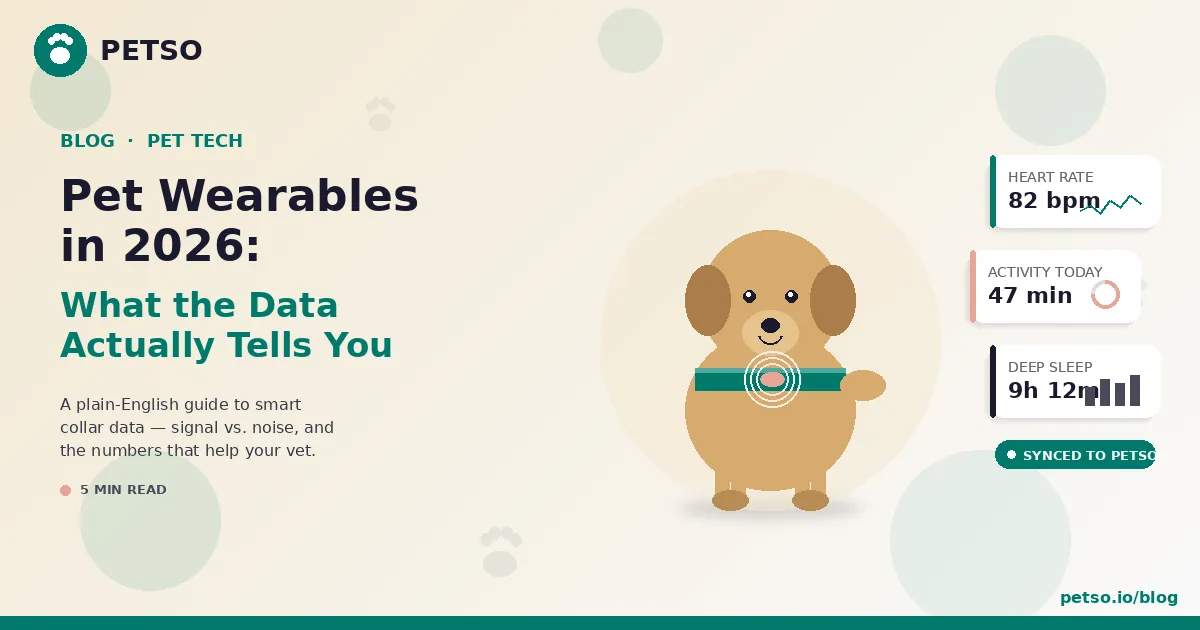
Your dog’s collar buzzed again. “Hudson had 47 minutes of moderate activity today, 9 hours of deep sleep, and 3 minor heart rate variations.” Lovely. Now what? If you’ve stared at your pet wearable app wondering whether to call the vet, order an extra chew toy, or just scroll on, you’re in good company. Pet wearables in 2026 have gone from novelty to near-default — the global pet wearable market is on track to top $13 billion by 2034, and CES 2026 alone brought a fresh wave of AI-powered smart collars. But more data isn’t the same as more clarity. Let’s talk about what those numbers actually mean, what they don’t, and how to turn a noisy feed of stats into something your vet can use.
Why Everyone Suddenly Has a Smart Collar
Five years ago, a pet wearable was a gadget you showed off at the dog park. In 2026 it’s closer to a baby monitor — a normal piece of household kit. Smart collars now account for roughly 45% of the category, and companies like SATELLAI, Fi, Whistle, and PetPace have pushed the feature bar from “where is my dog?” to “is my dog metabolically okay this week?” The latest devices pair GPS with accelerometers, skin-contact heart rate sensors, temperature probes, and on-device machine learning models trained to spot unusual patterns.
That’s a genuinely useful toolkit. Pets can’t tell us when something feels off, so continuous passive monitoring really does pick up signals humans miss. A cat whose nightly activity triples might be anxious. A dog whose resting heart rate drifts up by 8 bpm over three weeks might be developing pain or early heart disease. A senior Labrador whose deep-sleep time quietly drops by 20% could be the first clue that her joints are bothering her long before she starts limping. The appeal is real, and the sensors keep getting better.
But here’s the friction most owners hit. You have a dashboard full of charts and no intuition for which numbers matter, which are noise, and what your vet can actually do with the export file. The result is a slow creeping unease — a feeling that you’re either missing something important or over-reacting to a perfectly normal Tuesday. Neither is useful for your pet, and neither is a good reason to keep paying a monthly subscription.
What Pet Wearables Actually Measure — and What They Miss
Here’s the uncomfortable truth about pet wearables in 2026: the sensors are good, but the clinical validation behind them often isn’t. Heart-rate smartwatch studies have shown that some consumer devices agree well with veterinary monitors, and others really don’t. Long coats, wriggly cats, loose collar fits, and vigorous scratching all confuse the algorithms.
That means you need to read wearable data with a specific posture: it’s good at trends, poor at absolutes. The raw number your app flashes at you — “87 bpm resting heart rate” — matters far less than the change in that number over weeks, and whether it shifts alongside other metrics (less deep sleep, fewer active minutes, more pacing at night). Remote monitoring data should inform wellness conversations, not replace a physical exam.
There’s also a data hygiene problem that nobody warns you about when you unbox the collar. Your wearable’s app is one silo. Your vet’s clinic software is another. Pet insurance is a third. Grooming, boarding, the breeder who chipped her, the DNA test you did on a whim — each lives in its own account with its own export format and its own password you’ve already forgotten. When something goes wrong, you become the integration layer, usually from your phone in the vet’s waiting room while a stressed cat yowls in a carrier beside you. The wearable just becomes one more tab, not a unifying source of truth.
And privacy is the quiet elephant in the room. Your pet’s daily movements, vitals, and sleep patterns are surprisingly intimate data. In most jurisdictions, there is no veterinary-specific equivalent of HIPAA, so who owns that information — and who can sell it — depends on terms of service most owners never read. A 2026-era pet wearable strategy has to include a point of view on where the data lives and who gets to see it. If you can’t answer that question for your own dog, that’s a problem worth fixing.
How Petso Thinks About Your Pet’s Data
This fragmentation is exactly why we built Petso. Our view is simple: your pet generates a lifetime of signals — identity, health events, vaccinations, wearable metrics, ownership history, receipts, insurance claims — and those signals belong to one entity. The pet. Not the device maker. Not the clinic’s electronic records vendor. Not the app you used three phones ago.
Petso provides a single, owner-controlled digital profile for every pet, with verified identity and granular sharing controls. On the pet-owner side, the Petso app gives you a place to bring together wearable exports, vet notes, prescriptions, and milestones — so when a trend shows up in your smart collar, you can see it next to the bloodwork from last spring and the vaccination record from the breeder. On the veterinary side, Petso Pro gives clinicians an opt-in view of the same record, with the context they need in front of them instead of reconstructed from three phone calls and a screenshot.
The point isn’t to replace your wearable. It’s to make the data from it mean something in the room where decisions actually get made. A heart-rate drift across your dog’s last ninety days only helps if your vet can see it on the same screen as her last physical exam, her last vaccination, and the notes from the emergency visit she made while you were on holiday. Petso is the connective tissue between those moments — not another dashboard, but a record that travels with your pet.
We think the next real chapter of pet tech is not about more sensors on more collars. It is about giving pet owners a clean, portable, verified record they can carry between clinics, countries, and life stages, with wearable data sitting alongside everything else as one more useful input.
Four Ways to Actually Use Your Pet Wearable Data
If you’ve got a smart collar and you want to squeeze more value out of it this week, try these:
- Establish a baseline, not a verdict. Wear the device through two to three weeks of “normal” behaviour before you judge any reading. Your pet’s normal is personal, and the app’s generic breed averages are a starting point, not a diagnosis.
- Watch deltas, not absolutes. A 15% drop in daily activity sustained over two weeks is a signal. A single quiet Tuesday is not. Trends beat snapshots every time.
- Cross-reference two metrics before you panic. One anomaly is often sensor noise or a scratching session misread as a sprint. Two correlated anomalies — say, lower activity and higher resting heart rate — are worth a phone call.
- Export before the appointment. Most apps let you export a PDF or CSV of the last 30, 60, or 90 days. Attach it to your pet’s Petso profile and bring it to your vet. They will thank you, and they can actually act on a clean timeline instead of trying to reconstruct one from memory.
Small habits, big difference. The device does the sensing. You do the pattern-matching. Your vet does the diagnosing.
What This Means for You and Your Pet
Pet wearables in 2026 are finally good enough to be genuinely useful — and still unreliable enough that they need a thoughtful human in the loop. The win isn’t buying the flashiest collar; it’s building a workflow where the data lands somewhere it can be read, compared, and shared with the professionals who know your pet. That’s the real shift happening this year: from more gadgets to better joined-up records. Treat your wearable like a smoke detector — quietly helpful in the background, worth a calm investigation when it alarms, and never a replacement for the humans who actually keep your pet safe.
Ready to make your pet’s data work for you?
- Pet owners: Get started with Petso
- Vet professionals: Explore Petso Pro
- Learn more: Visit petso.io